
The Automation Adoption Gap in Financial Services
Dermot Bleeks, Managing Director at Cased Dimensions
Last updated: 16/11/2026
What is the automation adoption gap in financial services?
The automation adoption gap is the difference between deploying AI and automation tools and achieving an integrated, accountable and measurable business process. In financial services, it explains why firms with widespread AI use still reconcile spreadsheets by hand, chase approvals through email and struggle to show a return on their investment.
Contents
- How does the automation adoption gap show up in practice?
- How widespread is the gap in 2026?
- Why does the gap matter more in financial services?
- What are the main AI implementation challenges behind the gap?
- What does successful business process automation look like?
- How can financial-services firms close the gap?
- How should firms measure automation success?
- What should financial-services leaders do next?
- Frequently asked questions
How does the automation adoption gap show up in practice?
The automation adoption gap shows up when individual tasks get faster while the overall process stays slow. An organisation can roll out Microsoft Copilot, automate invoice extraction and introduce AI-powered customer service, and each tool can work exactly as intended, yet work still moves between departments, systems and decision-makers the way it did before.
Take a finance team that uses AI to prepare month-end reports. Commentary that once took hours now takes minutes. If the underlying data still needs manual reconciliation, departmental submissions arrive late and sign-off depends on email, the reporting cycle barely moves.
The task has improved and the business outcome has stayed where it was. Cased Dimensions draws the line between making tasks more efficient and redesigning the complete process that delivers a result. In financial services, where speed has to sit alongside accuracy, accountability and regulatory compliance, that line decides whether AI investment pays off.
How widespread is the gap in 2026?
The evidence from 2026 shows enterprise AI adoption moving considerably faster than the organisational change needed to realise its value.
McKinsey’s The state of AI in 2026 found that 44% of respondents reported AI scaling across their enterprise, while only 6% met McKinsey’s definition of an AI high performer. The same survey found 80% reporting personal productivity improvements and 37% attributing some positive effect on earnings before interest and taxes (EBIT) to AI. The two figures measure different outcomes, so they should be read side by side as evidence that individual productivity and business performance can diverge.
Deloitte’s State of AI in the Enterprise 2026 found that only 25% of organisations had moved at least 40% of their AI pilots into production, and just 21% reported mature governance for autonomous AI agents.
AI adoption in financial services is accelerating closer to home too. EY’s survey of 200 Irish CFOs and senior finance decision-makers found AI use within finance functions rose from 12% in 2025 to 47% in 2026.
Read together, these findings point to AI investment that is working at the level of tools and stalling at the level of processes. A firm can have widespread AI use and still run fragmented, labour-intensive processes held together by manual coordination. The more useful question for a board is which business processes have improved because of AI, and how that improvement can be demonstrated.
Why does the gap matter more in financial services?
The gap matters more in financial services because processes routinely cross departments, applications and external providers, and every step has to remain accurate, authorised and auditable. A single transaction or customer decision can draw on several systems, human approvals and regulatory checks. Automating one step leaves the dependencies around it in place.
Fragmented systems create manual handoffs
A firm may run modern finance software, a CRM platform, document management and automated reporting. If those systems cannot exchange information reliably, staff move the data themselves: downloading files, re-entering figures, investigating inconsistencies and confirming by hand that each stage is complete. That work consumes real operational capacity even where parts of the workflow are already automated. The opportunity lies in connecting existing technology, people and decisions into an end-to-end process, ahead of buying another tool.
Automation must preserve accountability
In regulated financial services, speed only counts when control comes with it. An automated payment, customer decision or reconciliation has to stay accurate, authorised and auditable, and when an exception occurs the firm needs to know what happened, who is responsible and how it will be resolved. As AI systems move from making recommendations to taking actions, firms must decide what an automated system can access, which decisions it can make, when a human must approve and how its actions can be stopped or reversed.
Operational resilience becomes more important
A process that once depended on one operator may now rely on an AI service, an integration platform, an identity provider and several connected applications. If any of them fails, the firm still has to manage outstanding work, keep accurate records and recover without losing control. Continuity planning, exception management and recovery procedures belong in the automation design from the start.
What are the main AI implementation challenges behind the gap?
The main AI implementation challenges behind the gap are organisational. Unclear process ownership, fragmented systems, inconsistent data and a focus on individual tools over complete outcomes combine to hold firms back. Research by Cased Dimensions identifies five transitions organisations have to manage.
- From tool adoption to redesigned workflows. Start with how the complete business process needs to change, then ask which tasks a product can automate.
- From successful pilots to supported production. A promising demonstration becomes a dependable service only once it has an owner, monitoring, maintenance and recovery arrangements.
- From task automation to end-to-end orchestration. Individual automated activities need to connect with the systems, approvals, exceptions and human decisions that complete the process.
- From claimed time savings to captured business value. Firms need to show whether higher productivity has improved throughput, operating cost, service quality or risk management.
- From autonomous action to controlled authority. As AI systems carry out multi-step activities, firms must define their permissions, operating limits and accountability.
These transitions often run in parallel. Some processes will be better served by conventional workflow automation or system integration than by generative AI. What they share is a requirement to treat enterprise automation as an operational improvement programme with technology inside it.
What does successful business process automation look like?
Successful business process automation produces a measurable improvement in the complete process. Two anonymised, client-reported outcomes from Cased Dimensions’ work with regulated financial-services firms, documented in The Automation Adoption Gap 2026, show the difference.
Pension member benefits processing: 77% faster
A regulated pension fund processed around 500 member benefits cases a year, with a typical end-to-end time of 13 weeks. After the process was redesigned and automated, the cycle fell to three weeks, a 77% reduction in elapsed time. Each stage is now documented and auditable. The gain covers the whole outcome, including the coordination and accountability the process requires.
Financial advisory commission reconciliation: a manual process replaced
A financial advisory firm replaced a manual commission reconciliation process with an automated, auditable workflow. The project began by mapping the existing process and measuring its baseline, so the firm could judge the improvement against the time and resources the old process consumed.
The pension fund cut elapsed processing time and the advisory firm recovered capacity from repetitive manual work. In both cases the value came from improving the process itself, and both firms could prove it because they measured at process level.
How can financial services firms close the gap?
Financial-services firms close the automation adoption gap by understanding how work currently moves through the organisation before choosing which technology to introduce or expand.
Cased Dimensions places particular weight on the Process Ownership Gap. It occurs when responsibility for individual tasks or systems is clear and accountability for the complete outcome is missing. IT might maintain the automation platform, finance might manage the source data and an operations manager might approve exceptions. If nobody owns the process from trigger to completion, delays persist even while every team meets its own responsibilities. Each automation initiative needs an accountable process owner who monitors performance, manages exceptions and coordinates improvement across team boundaries.
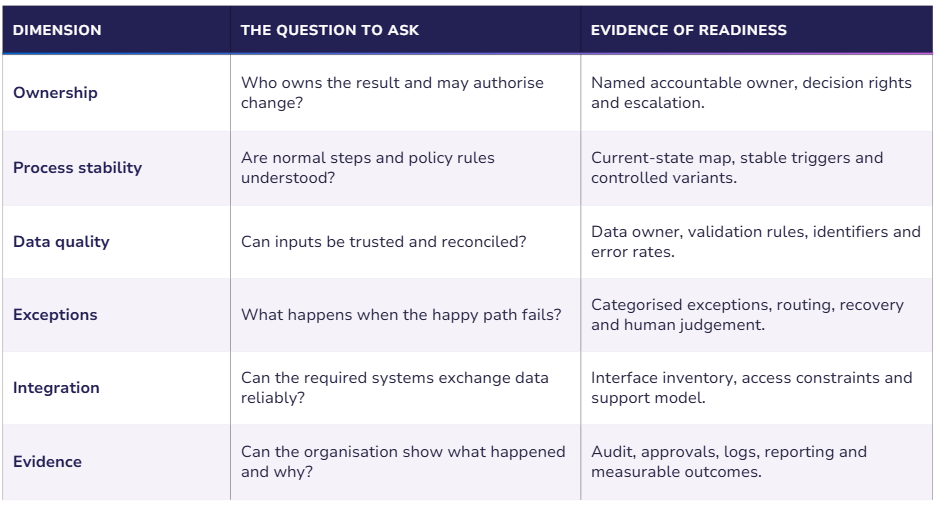
Readiness comes next. The Cased Dimensions Automation Readiness Model assesses six dimensions: ownership, process stability, data quality, exception handling, integration and evidence. Together they show whether a process is understood, controlled and measurable enough to benefit from automation. A process with unstable data, unclear approvals or unresolved integration dependencies may need foundational work first.
With ownership and readiness established, firms can pick a specific process, measure its current performance, agree the outcome they want and then choose the right mix of workflow automation, system integration, human oversight and AI.
How should firms measure automation success?
Firms should measure automation success by the performance of the complete process. Counts of deployed automations, AI licences or completed tasks are useful operational data, and they say little about value on their own.
For finance and IT leaders, stronger indicators are end-to-end cycle time, the amount of manual intervention still needed, case volumes and the rate of errors and exceptions. Operating cost matters too, once implementation, support, licensing and exception handling are included.
Time saved and money saved are separate measures. An automation that frees 200 hours a year creates capacity, and the firm still has to show how that capacity is used and whether it raises throughput, improves service or lowers cost. In regulated environments, the measures should also cover audit completeness, control effectiveness and the ability to keep essential operations running during disruption.
What should financial services leaders do next?
Financial-services leaders should start with one process that has an identifiable business problem: a reconciliation consuming significant manual effort, a customer-facing process with long delays or an approval chain creating friction.
Establish who owns the outcome. Map the process from beginning to end and mark the points where work waits, information changes hands or exceptions need intervention. Then assess whether the process is ready for automation and what improvement would justify the investment.
The Automation Adoption Gap 2026 sets out a practical framework for that assessment, including the Automation Readiness Model and a 90-day approach to identifying and implementing controlled improvements. The firms that pull ahead will be those that can show their technology has changed how the business operates.
Frequently asked questions
What is the difference between AI adoption and automation maturity?
AI adoption measures whether an organisation uses AI technologies. Automation maturity measures how well technology is built into business processes. A mature automated process has a clear owner, connected systems, defined controls and measurable outcomes, so it can be shown to deliver results to a board, auditor or regulator.
Why do AI investments fail to deliver measurable ROI?
AI investments struggle to deliver measurable ROI when firms target individual productivity over end-to-end process improvement.
Manual handoffs, fragmented systems, unclear accountability and missing performance baselines stop efficiency gains at the task level from reaching operating cost, throughput or risk, where a return can be measured.
Does every business process need AI to become automated?
Many business processes can be automated without AI. Rules-based automation, APIs, workflow orchestration and better system integration often deliver the improvement on their own.
AI earns its place where it meets a specific process requirement, such as reading unstructured documents or classifying exceptions.
How can a financial services firm identify its first automation opportunity?
A financial services firm should start with a high-volume or time-consuming process that has an identifiable owner, reasonably stable inputs and a measurable business outcome. Assess its data quality, exceptions, dependencies and control requirements before deciding which technology to use.
About the author
Dermot Bleeks is Managing Director of Cased Dimensions, a managed IT, cybersecurity and business automation provider serving mid-market organisations and government bodies across Ireland and the UK.
Read The Automation Adoption Gap Report 2026
The full report sets out why AI adoption is moving faster than process transformation, where the greatest opportunities lie in financial services and how to build a practical roadmap towards measurable improvement.
Read the full report or complete the Automation Readiness Scorecard to see where your organisation stands and which improvements to prioritise.